WHAT THE PROJECT IS ABOUT:
Overbaked & Underproofed proposes to look closely at the language used in the judging segments of The Great British Baking Show (GBBS), a reality TV baking competition that has been on-air for more than ten seasons and has been one of the most-streamed original tv-shows in the US during the pandemic. As the only reality TV show in the top 15, it placed third in the “original content” category, only surpassed by Lucifer and Squid Game in 2021. GBBS accumulated more than 13 billion viewing minutes on streaming platforms in 2021.
Overbaked & Undreproofed (Ob&Up) is named for two of the most common words used by the judges when critiquing the “bakes” created by contestants, and these two words might already represent 10% of the limited judging vocabulary in use.
The project wants to probe how evaluative language works in GBBS and illustrate why the narrow vocabulary of judgment fundamentally fails to transmit anything evocative about the multi-sensory nature of the often complex edible objects at the competition’s center. Instead, Ob&Up argues, this paucity of language further flattens our screen-mediated relationship to the sense of taste. GBBS diverts attention from the lack of descriptive language by relying exclusively on visual elements. As viewers, we must taste with our eyes only.
Nuanced and descriptive language, which could take us beyond the visible, does not attempt to expand our experience. For example, the judges might only let us know that while a cake looks beautiful, its “flavors aren’t coming through .” Hm. As an audience member savoring and exploring what is tasted along with the judges is not available as an option. This discrepancy between the visual and the verbal points to the way in which —in the televised and virtual worlds— all senses seem to be required to recede and grant primacy to the visual. Considering the power of descriptive language to appeal to other senses in a medium that cannot produce taste, smell, and touch, the project wants to consider how this reliance on visual primacy excludes some audiences entirely and limits all audiences considerably.
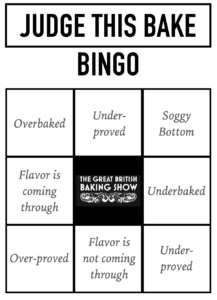
To allow viewers of GBBS to explore how sparse and evaluative language contributes to a sub-par experience of “the bakes,” Ob&Up wants to mix an academic approach with a playful one. Part of the objective is to develop a watch party bingo game (see a low-tech version above) that viewers can play and then share via social media. By guiding viewers’ awareness to notice evaluative expressions, the simplistic framework of judgment, and the bland experience they offer, Ob&Up aims to induce a shift towards more conscious media consumption, ultimately producing a new and expanded media literacy.
SKILLS THE PROJECT WOULD HELP US DEVELOP AND PRACTICE:
Realizing this project would give us the opportunity to:
- Create and annotate/tag/organize a unique corpus (by extracting judging language from one season of the show)
- Work with text analysis tools and methods to explore the corpus and probe for other linguistic patterns, which might let us formulate additional research questions and yield additional insights
- Utilize data visualization tools to make our findings legible for a public audience
- Present a narrative of our findings to the audience via a website and social media
- Think about, develop, and integrate a simple “judge-this-bake” bingo game, which would serve a pedagogical function by fostering critical viewing via interactive engagement. (This could be a downloadable and printable bingo card.)
AND ONE MORE NOTE:
Alan Liu’s question “Where is Cultural Criticism in the Digital Humanities?” has been hugely influential in developing this idea, and Liu’s text is the reason why the project’s focus is on using the insights and evidence a new corpus can yield to investigate aspects of a cultural phenomenon. An endeavor that wants to explore, contextualize, and criticize a recent artifact of popular culture (an artifact like GBBS that is often coded as trivial, low-brow, and feminine) by employing DH methods can serve as an example of DH-informed cultural criticism and can also help to bring DH approaches to a broader audience. The playful context of the project should appeal to the many people who are fans and viewers of GBBS, as well as to people interested in linguistic and rhetorical aspects of evaluative language and the connection between language and the rendering of the sense of taste in digital environments.